ServicesVehicle Restraints
Vehicle Restraints in Freeland
A vehicle restraint holds the trailer against your dock so it cannot creep or pull away while a forklift is inside. We repair, adjust and install hook-style and wheel-based restraints, then tell you plainly what failed, why, and what your choices are.
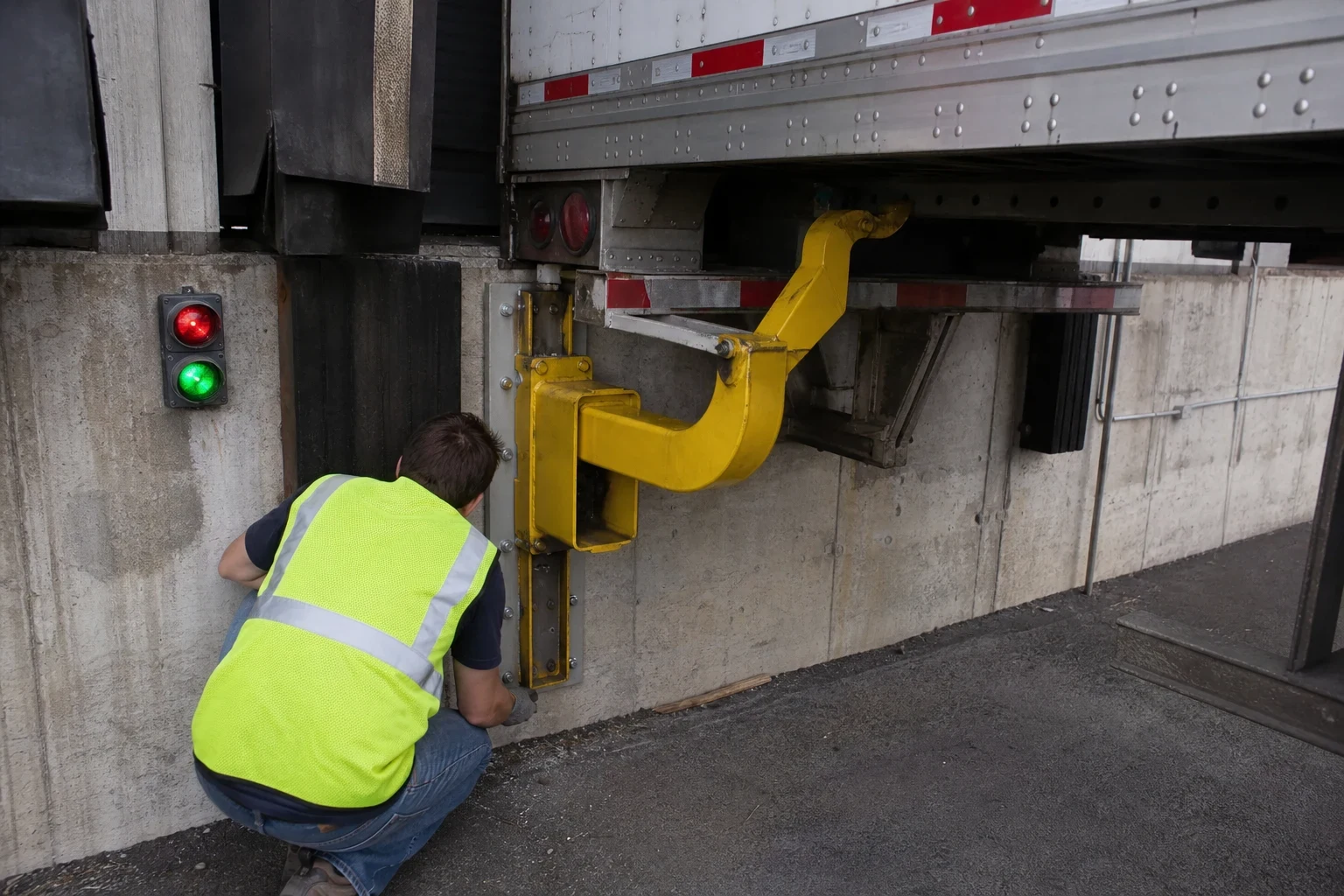
What a Vehicle Restraint Does and When It Needs Work
Most dock restraints work one of two ways. A hook-style unit rides on a carriage mounted to the dock face and rotates a steel hook up behind the trailer's rear impact guard, often called the ICC bar or RIG. A wheel-based unit blocks the trailer's rear tires instead, which helps with trailers whose impact guard is bent, missing or sits at an odd height. Both are paired with a red and green light system so the driver and the forklift operator know who may move.
When a restraint stops engaging fully, your crew starts using the override or going back to loose wheel chocks. That is the moment to call. Trailer creep and early pull-aways are how dock plates drop and forklifts end up between the trailer and the dock, and the fix is usually smaller than people expect: a worn spring, a jammed carriage, a failed sensor or a burned-out light.
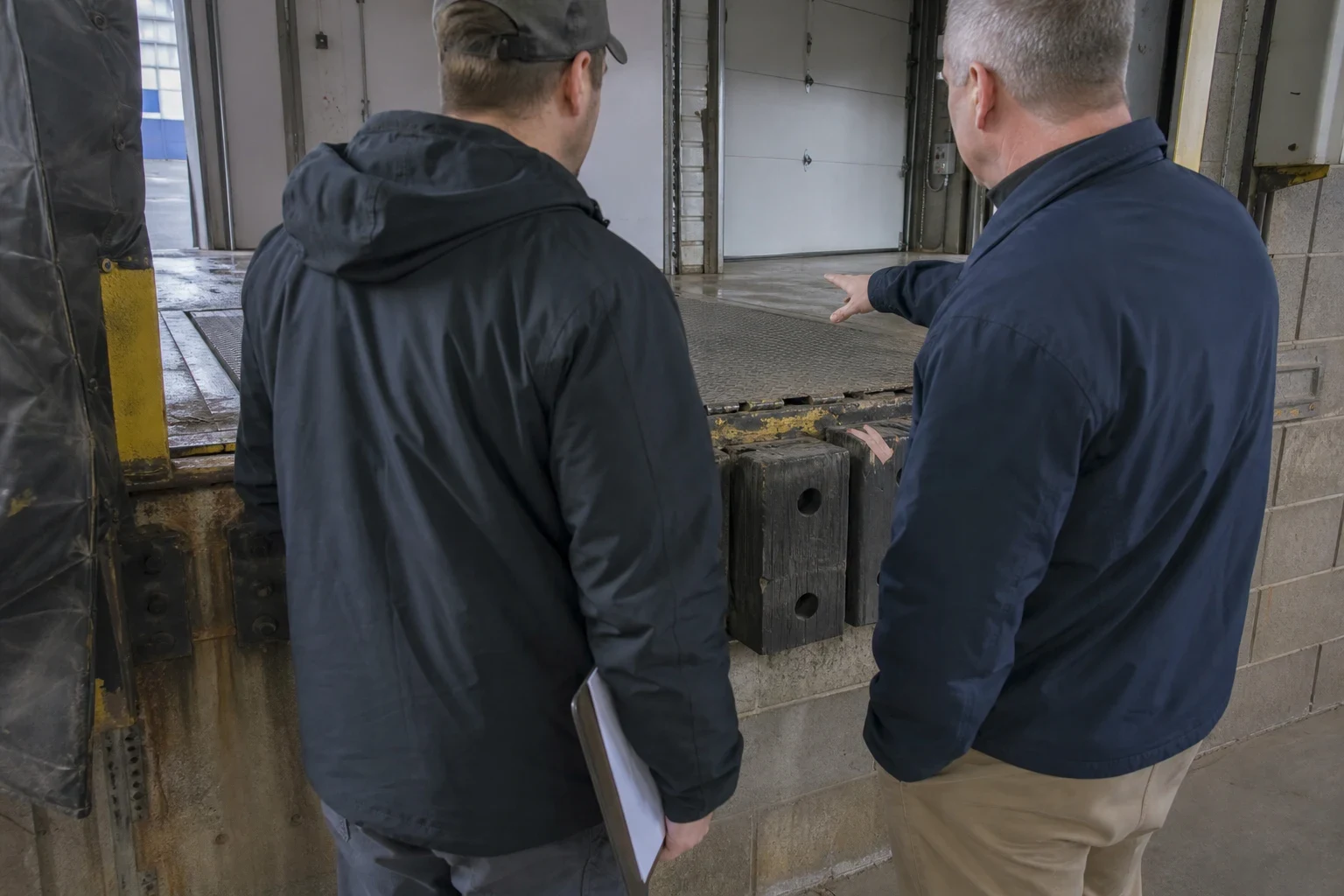
What Our Restraint Service Covers
- 01
Hook and carriage repair
We check hook rotation, the carriage's travel up and down the track, and the springs or hydraulics that keep the hook pressed against the bar. Bent hooks, seized rollers and broken return springs are replaced, not just greased and left.
- 02
Wheel-based restraint service
For units that block the tires, we inspect the barrier arm, the track or ground plate it travels in, and the drive that positions it. We clear packed debris and check that the arm locks at the correct height for the tire.
- 03
Motor, hydraulics and controls
Powered restraints fail at the motor, the hydraulic power unit, the limit switches or the control panel. We test each with a meter, find the actual faulty component, and explain it before replacing anything.
- 04
Lights and communication
Inside and outside signal lights, the outdoor driver sign and any audible alarm are tested so they change state exactly when the restraint engages or releases.
- 05
Interlocks with the leveler and door
If your restraint is wired to the dock leveler or overhead door, we confirm the sequence works: no leveler operation until the trailer is held, no release while the lip is on the trailer bed.
- 06
New restraints and retrofits
Where a unit is past repair or a dock never had one, we cover replacement options here and handle the full job through our Loading Dock Equipment Installation service.
Questions about Vehicle Restraints?
Call(570) 521-9737Signs Your Vehicle Restraint Needs Attention
The hook stops short of the bar
If the hook rises but leaves a gap behind the impact guard, the trailer can still move. Common causes are a weak spring, a dragging carriage or a sensor that tells the hook it has made contact too early.
Crews keep using the override
Frequent overrides mean the restraint is not reliable enough for the people using it. That habit is a safety and compliance problem on its own, separate from whatever mechanical fault started it.
Lights stuck on one color
A green light that never turns red, or a red that never clears, removes the one signal the driver and forklift operator share. Sometimes it is a lamp, sometimes a switch or relay.
Grinding, slow travel or stalling
Noise and hesitation usually point to debris in the track, corroded rollers or a motor pulling more current than it should. Winter salt and packed ice make this worse at outdoor docks.
Visible impact damage
Trailers backing in hard can bend the carriage housing or crack the mounting welds. A restraint that has been hit should be inspected before it is trusted again.
How a Restraint Service Visit Runs
- 1
Start with a phone call
Tell us the make if you know it, whether it is a hook or wheel unit, and what the crew is seeing. That lets us bring likely parts and plan around your receiving schedule.
- 2
Inspect and test at the dock
We lock out the unit, check the mechanical parts, then run it with power through several engage and release cycles. If a trailer is available, we test against a real impact guard, because the bar height on real trailers varies.
- 3
Explain what we found
You get a plain answer on what failed, why it failed, and whether repair or replacement makes more sense, with a written estimate before the work starts. We show you the worn or broken parts.
- 4
Repair and verify
After the repair, we cycle the restraint again with the lights and any interlocks, and walk your dock lead through the correct operating sequence. Our Loading Dock Preventative Maintenance visits can keep it on a regular inspection schedule from there.
What Moves the Cost of Restraint Work
Restraint repairs range from a single switch to a full carriage rebuild, so the price depends on what we find. We give you a written estimate after inspecting the unit, and we explain each line so you know what you are paying for.
- Type of restraint
- Manual hook units have fewer parts than powered hook or wheel-based systems. Powered units add motors, hydraulic pumps, limit switches and controls, and each can be its own repair.
- Parts availability
- Current models usually have parts on the shelf. Older or discontinued units may need substitute components or adapter work, which adds labor.
- Dock face and mounting condition
- A restraint is only as solid as what it bolts to. Spalled concrete, cracked welds or a damaged steel face plate have to be repaired before a new or reset unit can hold properly.
- Lights and interlock wiring
- Adding or repairing communication lights, or tying the restraint into a leveler and overhead door sequence, means extra wiring and control work.
Vehicle Restraint Questions
Should we use a hook-style or wheel-based restraint?
Hook-style restraints are common and work well when the trailers you receive have intact impact guards at standard heights. Wheel-based units grab the tires, so they handle damaged or missing bars, lift-gate trailers and some specialty equipment that a hook cannot catch. We look at the mix of trailers at your docks before recommending either.
Can a restraint be added to a dock that never had one?
Usually, yes. Hook units mount to the dock face, and wheel-based units mount to the drive approach, so we check the concrete, the bumper layout and available power first. If your dock leveler is older, we also check whether an interlock is practical.
Do we still need wheel chocks if we have a restraint?
A working restraint is designed to secure the trailer on its own, and many facilities use it in place of chocks. Some carriers and company safety programs still require chocks as a backup, so follow your own policy. What matters most is that one reliable method is used on every trailer.
Why does our restraint fail more in winter?
Ice and packed snow in the carriage track or around a wheel unit's barrier keep parts from traveling fully, and road salt corrodes rollers and springs. Around Freeland, clearing the track and checking the unit before the cold sets in prevents a lot of mid-season calls.
How often should restraints be inspected?
High-traffic docks benefit from inspections every few months, lighter-use docks less often. A routine check covers hook travel, spring tension, lights and controls, and catches wear before it turns into downtime.
Get Your Restraints Holding Trailers Again
Tell us what the restraint is doing and what type you have. We will come out, find the cause, and explain your options before any work begins.